Latest updates

Every new feature and improvement, newest first.

Every metric the app shows is defined in the glossary, also linked in the footer: Glossary

3.8.1

August 8, 2026

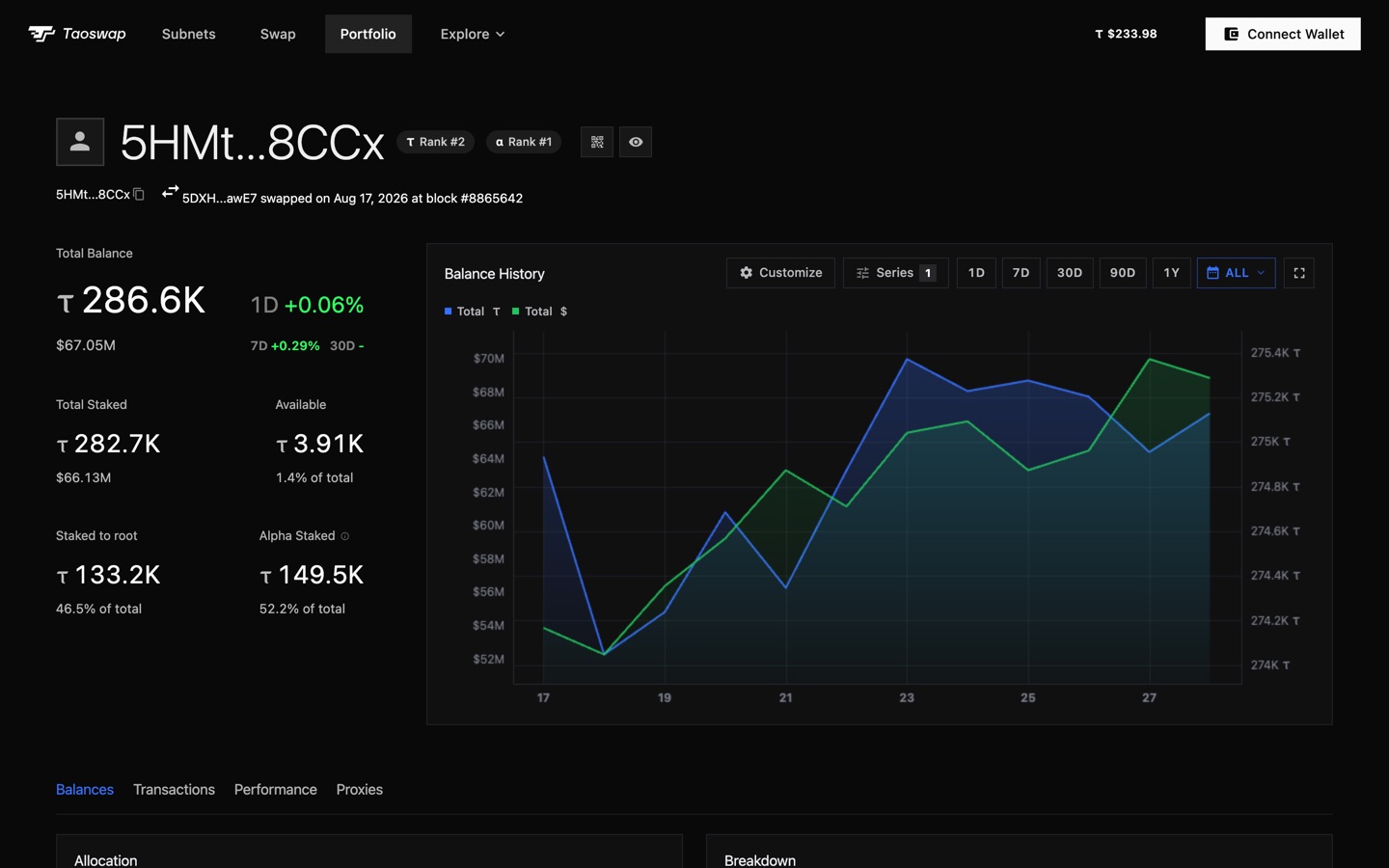
Your receive address, as a QR code

Sharing a Bittensor address by copy and paste stops working the moment it has to cross from one device to another. Your portfolio now carries a button that opens it as a QR code, to show whoever is sending you TAO. The code encodes the address alone, with no amount and no prefix, because wallets do not all read those the same way and an amount one wallet honours while another ignores it is a trap. The full address stays written under the code, never truncated, and copies in one tap.

  • The dialog tells you whose address it isThe portfolio can display any public address, not only yours. When the one on screen is not one of your connected accounts, the title changes and a warning says so, so nobody scans a stranger's address believing it is their own.

A fund's APY, measured over the time it actually ran

A fund's APY was annualised from a single day. That turns one good day into a yearly promise and one bad day into a disaster, when a fund a few weeks old has proven nothing about a year. It is now measured from the fund's inception, over its real age, and the number of days it covers is written next to the figure.

  • The figure is coloured againPerformance since inception stayed grey whatever its value, while the line right below it did turn green or red. Both now follow the same code.
  • No more "null d" or $0.00 market capsTwo readouts that surfaced when the data was missing instead of staying quiet.

The token picker showed only one root position

Root stake is held validator by validator: an account staked to eight validators owns eight distinct root positions. The token picker listed one of them, always the same one, and the other seven were not merely pushed further down the list, they were unreachable. All of them are listed now, each with its validator. The portfolio had been counting them correctly all along, which made the gap all the more confusing.

  • And an order that stops movingTwo positions on the same subnet came out in whatever order the chain returned them, so the list could rearrange itself between refreshes. The largest now comes first, with the hotkey breaking ties.

Three display fixes

Nothing spectacular, three things that got in the way.

  • The validators table held less well than it couldHeaders now carry their qualifier as a prefix, which shortens them without making them ambiguous, and the hotkey column was claiming 120 pixels for 62 pixels of content.
  • The flows card overflowed on mobileOn a validator's Fund tab it ran outside its track instead of staying in it.
  • Unavailable pages centred too highThe "temporarily unavailable" block centred itself inside a fixed box pinned under the header, so it read as top-aligned with empty space below. It now fills the height that is actually visible. Six pages are affected, the testnet faucet among them.

3.8.0

August 6, 2026

Staking rewards, and a Claim that works again

You could already claim your root rewards, the old way. Root Reborn ended that way: the chain stopped filling the counter the app was reading, so the button had quietly vanished for everyone, along with the swap-or-keep setting it offered. Nothing was lost, those rewards sit in your validator's fund. Your portfolio now shows them under Staking rewards, and Claim goes through the Root Reborn call, with its measured fee printed on the button. The breakdown by validator sits behind a fold, closed by default because most holders have only one, and each row opens its validator's page.

Staking rewards, and a Claim that works again

A validator's fund, hour by hour

That fund is now readable from the outside. A validator's page has a Fund tab that reads it hour by hour over the last 7 days, and each chart carries its axes, its gridlines and a crosshair that names the value under your pointer.

A validator's fund, hour by hour
  • What the fund is worthThe total value of everything the fund holds, valued at what a sale would actually fetch rather than at the screen price.
  • What a holder earnedNot the same question, and the difference matters. A fund's total grows on deposits as much as on earnings, so the value curve can climb steeply while a holder earned almost nothing. The share price answers what your shares did.
  • Money in and money outDeposits and redemptions on one chart and one scale, so the gap between them reads in TAO. Given their own axes, a redemption of 2 TAO against 250 TAO paid in would have filled its own card and looked like an exodus.
  • A yield measured over one windowThe share price change and the APY are both measured over exactly 24 hours, and both say so, so the two can be read against each other.
  • The curves end where the numbers doThe figures on the cards are read live from the chain while the curves come from hourly snapshots, which is exactly how a card and its chart end up disagreeing. Every curve is carried to the live reading, so they cannot.

The lists took a second to catch up

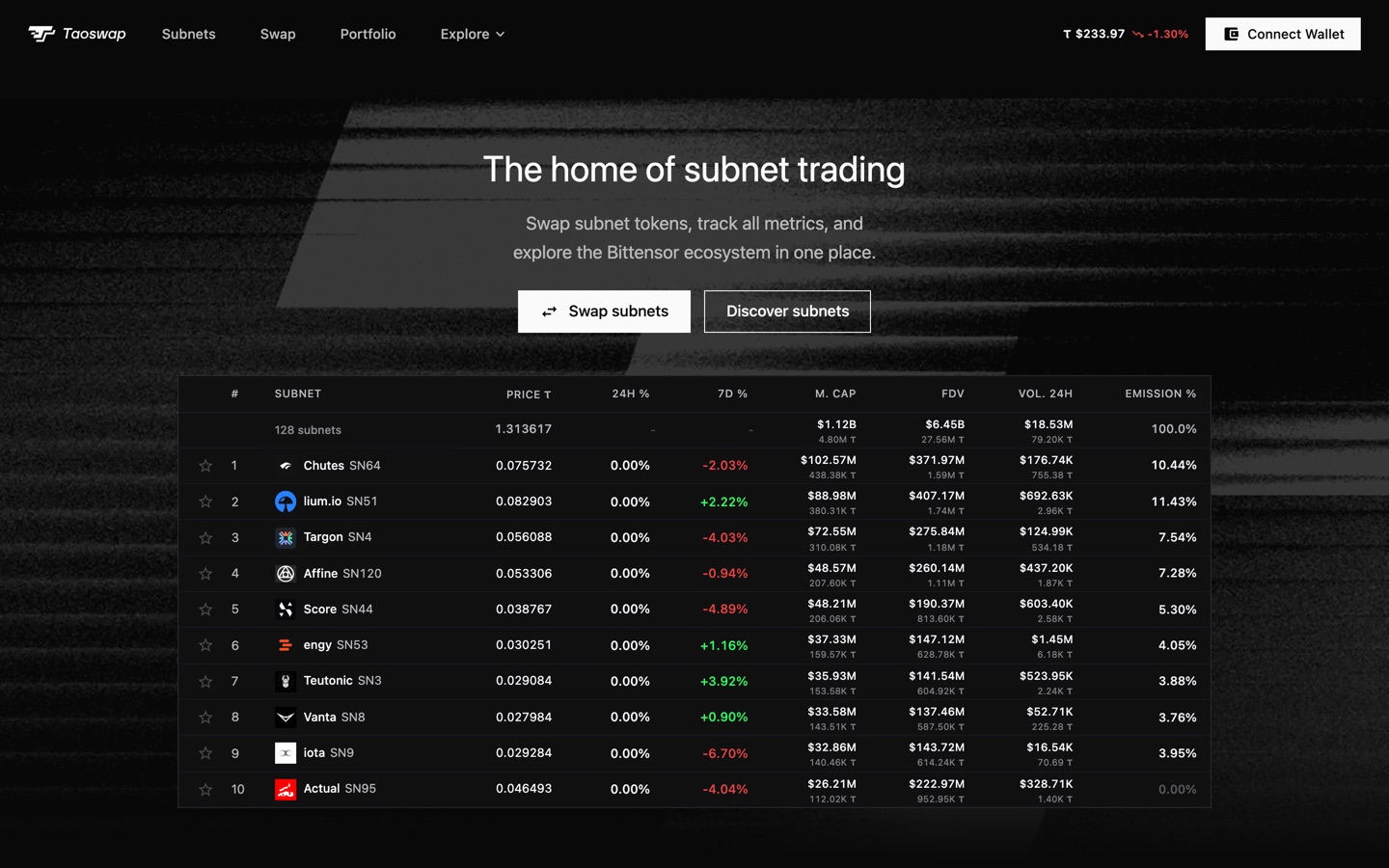
Opening the subnets or validators list showed a table that was out of date, the prices and every other column with them, and a second or two later the whole table jumped to the current numbers. The lists now load the current table from the start, so nothing changes under your eyes.

How MUV picks the weights it aims its fund at

A validator can point its fund's dividends at chosen subnets. MUV aims at the 64 subnets earning the most emission, each weighted by its market cap, and the full target now opens in one click from MUV's Fund tab: the method, the reasoning, and the whole table with each subnet's UID, market cap, emission and weight. Buying a subnet the chain pays nothing to is paying for something that has stopped producing, so those are out. It is our position, published so it can be compared, and nothing more than that.

Emissions read as a share of the total again

On Compare, the emission curve was drawn in TAO per block, around 0.001, which was unreadable and impossible to line up with the Emission % column of the subnets table. It is now the same percentage as that column. A subnet's Emissions card was affected too, and its Chain Buys card had been reading a hundred times too low since mid July.

Smaller fixes

Three small ones.

  • The top bar lost its backgroundOpening any dialog made the header go transparent over the page behind it.
  • NAV, defined where it is usedA fund's value is a NAV, its net asset value, and the word turns up wherever funds do. The glossary defines it, and the card carries that definition in its tooltip rather than assuming you know it.
  • A subnet logo could send a request per rowIdentity images with a relative address were resolved against the current page, so a table full of them fired one dead request per line.